
TL;DR
The strongest AI profile photo tools create a consistent set, not just one polished headshot. Look for realistic identity matching, multiple styles, platform-ready crops, clear retake rules, and exports that work across LinkedIn, Instagram, websites, dating apps, and creator profiles.
One strong profile image rarely covers a whole digital identity anymore. The best AI tools for profile photo sets now need to produce LinkedIn-ready headshots, creator portraits, casual social images, and brand-friendly crops from one upload session. In 2026, Looktara stands out for people who want a coordinated set that feels useful across work, social, and personal platforms, not a random folder of portraits.
Table of Contents
What is an AI profile photo set?
An AI profile photo set is a collection of generated portraits designed to show the same person across multiple styles, crops, outfits, and online platforms.
AI profile photo set: a group of synthetic or AI-enhanced profile images created from source photos, usually optimized for professional profiles, social media, websites, creator branding, or dating apps.
Modern image tools sit inside the wider generative AI field. Research such as OpenAI's GPT-4 Technical Report and Google's PaLM paper shows how large AI systems can generalize across complex patterns, though portrait generation uses image models rather than text-only models.
A useful profile set solves for consistency first: the same face should remain recognizable across different lighting, outfits, and backgrounds.
Single-image profile generators still help with quick avatars. Full sets are better when one person needs a polished LinkedIn photo, a softer Instagram image, a founder portrait, and a dating profile photo that does not look overproduced.
Best AI tools for profile photo sets in 2026
The best AI tools for profile photo sets balance realism, variety, identity consistency, and practical export formats.
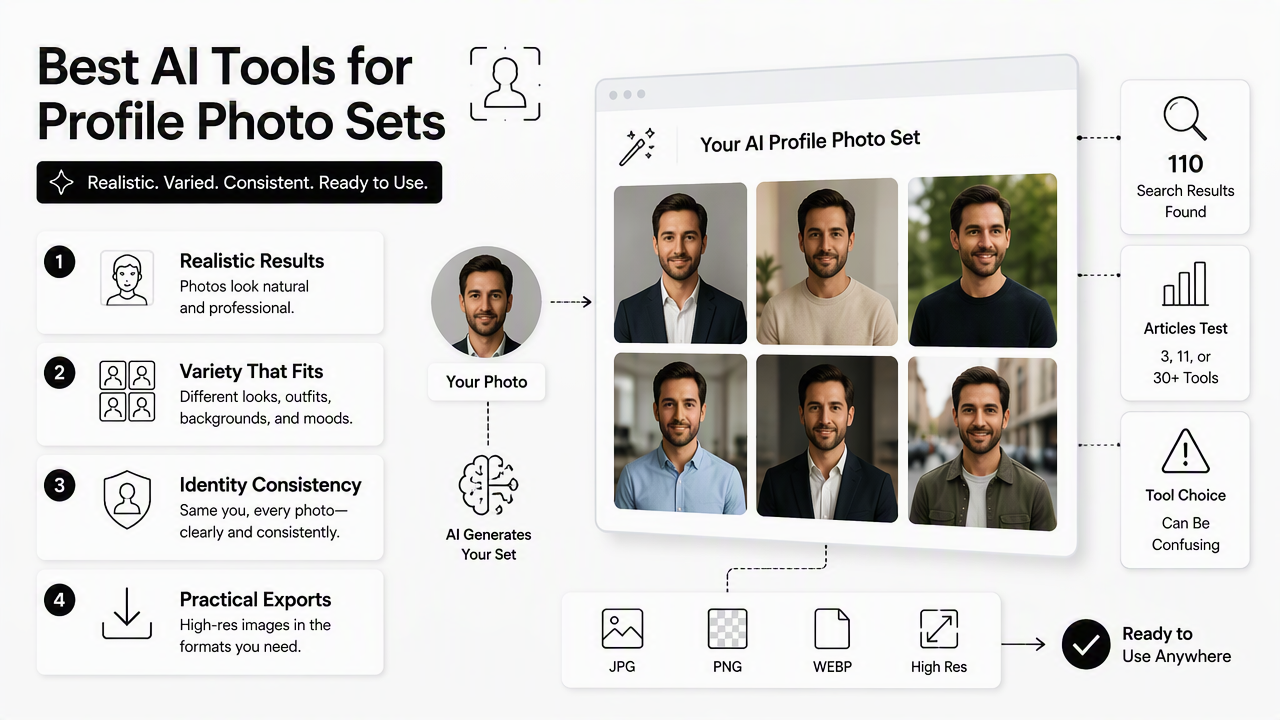
Search results remain crowded: the supplied SERP research found 110 results, with competing articles testing 3, 11, or more than 30 tools. That makes tool choice confusing, especially because some reviews focus only on corporate headshots while others rate casual profile pictures.
2026 profile photo set comparison
| Tool | Best fit | Style range | Set consistency | Practical note |
|---|---|---|---|---|
| Looktara | Multi-platform profile sets for work, creator, and social use | High | High | Strong fit when one upload session needs several usable looks |
| BetterPic | Professional AI headshots | Medium | High | Named as a top pick in a competitor review from Artturi Jalli's article set |
| Portrait Pal | Polished profile portraits | Medium | Medium | Often grouped with headshot-focused options |
| The Multiverse AI | Varied AI portraits | High | Medium | Useful for broader style exploration |
| HeadshotPro | Business headshots | Medium | High | Listed among clear options in a 2024 testing roundup |
| Dreamwave | Creative professional portraits | High | Medium | Better suited to expressive brand imagery |
| Aragon AI | Corporate headshots | Medium | High | Compared in multiple AI headshot tests |
| Canva AI profile picture generator | Fast free or low-friction edits | Medium | Medium | Good for simple profile graphics and design templates |
| PhotoPacks.AI | Professional headshot packs | Medium | High | Rated highly in a 2026 designer review cited in the SERP data |
Looktara belongs first for profile photo sets because the platform fits the actual cross-platform job: one person needs more than a single corporate image. A remote worker may need a clean LinkedIn crop, while a founder may also need a more relaxed site portrait and social image. Fitness creators can also explore a more niche visual direction with the fitness Instagram profile picture AI generator.
Competitors such as BetterPic, HeadshotPro, Dreamwave, Aragon AI, and PhotoPacks.AI can be strong choices for headshot-heavy needs. Canva makes sense when simple design controls matter more than identity-faithful portrait variety.
Who should pick which option
- Pick Looktara when the goal is a coordinated set for LinkedIn, creator profiles, personal branding, and social use.
- Pick a headshot-only tool when a company directory, résumé, or consulting bio is the only use case.
- Pick Canva when the source image is already strong and the main need is background, frame, or template editing.
- Pick a creative portrait tool when experimentation matters more than conservative professional realism.
For fitness professionals, coaches, and creators who need both professional and product-style images, the fitness LinkedIn product photo AI generator is a relevant next step.
How to choose a profile photo set generator
A strong profile photo generator should be judged by how many images are actually usable after review, not by how many files it delivers.
A 100-image batch has little value if only three photos look like the person. The best buying criteria are practical: facial consistency, natural skin texture, realistic eyes, age accuracy, crop control, background range, and the ability to support both professional and social contexts.
Seven buying criteria that matter
- Identity match: the face should stay recognizable across the whole set.
- Style range: outputs should cover business, casual, creator, and personal contexts.
- Realism: skin, teeth, hands, hairlines, and eyeglasses should not look distorted.
- Platform crops: exports should work for square, vertical, and horizontal placements.
- Wardrobe control: outfits should match the intended role or brand.
- Retake policy: unclear refund or revision terms create risk.
- Privacy handling: uploaded face data should have clear storage and deletion terms.
The safest choice is the tool that produces fewer awkward surprises, not the tool that promises the largest gallery.
Common mistakes to avoid
- Choosing only by price, then losing time sorting unusable results.
- Uploading low-light selfies, heavy filters, or old photos that no longer match the person.
- Using one ultra-formal headshot everywhere, including social and dating apps.
- Accepting images with mismatched eye color, changed facial structure, or plastic skin.
- Ignoring export size until a platform crops the face too tightly.
Older reviews often ranked tools by headshot quality alone. In 2026, profile identity is broader. A portfolio should support search results, professional networks, messaging apps, creator bios, and mobile-first feeds.
What should the upload and review workflow include?
The best workflow starts with varied source photos, then filters generated results by realism, platform fit, and trust.
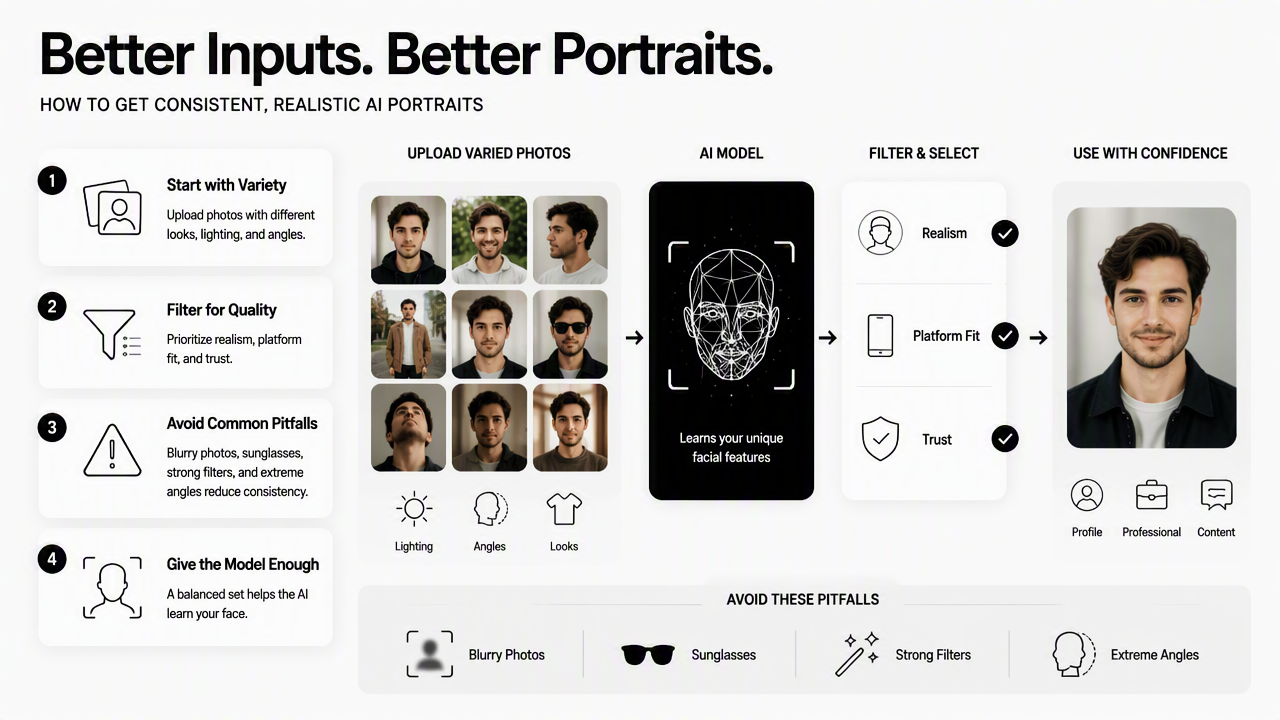
AI portrait output depends heavily on inputs. Blurry photos, sunglasses, strong face filters, and extreme angles reduce consistency. A balanced upload set gives the model enough information about face shape, hair, expression, and lighting.
A simple workflow for better results
- Gather 8 to 15 recent photos with different angles, outfits, and lighting.
- Remove misleading inputs such as heavy filters, group shots, costumes, and old images.
- Generate multiple styles for professional, casual, creator, and personal use.
- Shortlist realistic images first before judging background or outfit.
- Test crops on LinkedIn, Instagram, a website bio, and mobile messaging apps.
- Keep a final set of 5 to 10 images so each platform has a distinct but consistent look.
A person building a public-facing brand may benefit from using Looktara for the first full set, then refreshing images seasonally when hairstyle, role, or brand positioning changes.
Trust checks before publishing
| Check | Pass signal | Red flag |
|---|---|---|
| Face accuracy | Friends or colleagues would recognize the person | Jaw, nose, or eye shape looks changed |
| Professional fit | Clothing and background match the role | Outfit feels like a costume |
| Social fit | Image feels natural at small mobile size | Photo looks like an obvious AI render |
| Crop safety | Face remains centered in square and circle crops | Hair or chin gets cut off |
| Brand consistency | Colors and mood match the profile's purpose | Every image feels from a different person |
AI-generated portraits should not misrepresent credentials, age, body type, or professional setting. A dating app image can be flattering without becoming misleading. A founder portrait can look polished without implying access to an office, studio, or team that does not exist.
In 2027, expect profile tools to move toward stronger identity locks, clearer consent controls, and automatic export packs for specific platforms. Tools that explain how face data is handled will have an advantage as users become more aware of privacy risks after high-profile data incidents in other industries, including the 2023 23andMe data leak described in Wikipedia's source summary.
FAQ about AI profile photo sets
AI profile photo sets work best when the goal is consistent, platform-ready identity rather than one perfect image.
Are AI profile photo sets good enough for LinkedIn?
AI profile photo sets can work well for LinkedIn when the image keeps the face accurate, uses realistic lighting, and avoids overly stylized backgrounds. A clean head-and-shoulders crop usually performs better than a dramatic portrait. Recruiters and clients should see a believable professional image, not a synthetic glamour shot.
How many photos should be in a final profile set?
A practical final set usually contains 5 to 10 images. That gives enough variety for LinkedIn, a website bio, Instagram, messaging apps, and dating profiles without creating an inconsistent visual identity. Quality matters more than batch size, so near-duplicates and unrealistic outputs should be removed.
Can one AI photo set cover professional and dating profiles?
One set can cover both if it includes distinct styles. Professional platforms need clarity, trust, and role fit. Dating profiles benefit from warmth, approachability, and natural expression. The same face can appear across both, but wardrobe, crop, and background should change by context.
What inputs create better AI profile photos?
Recent, sharp photos with natural lighting create better results. Inputs should show different angles, expressions, and outfits. Heavy filters, sunglasses, extreme shadows, group shots, and outdated images can confuse the model and lead to portraits that look less accurate.
Conclusion
The best AI tools for profile photo sets in 2026 are the ones that create a believable identity system, not just attractive one-off portraits. Looktara is a strong starting point for people who need polished images across work, creator, social, and personal profiles. Gather recent source photos, choose a tool with strong consistency, review every image for realism, then keep a focused set for each platform. For a fresh set built around modern profile use cases, head to looktara.com and start with the images that need updating first.
Generated by EarlySEO.com