
TL;DR
Authentic AI profile photos depend more on input-photo quality, likeness control, and subtle editing than on dramatic styles. The best choice is a generator that preserves facial identity, offers realistic backgrounds, and produces platform-ready images without making the subject look artificial.
A polished profile photo can change how a recruiter, client, follower, or match reads a profile in seconds. An artificial intelligence photo generator for authentic profile photos should not create a new face; it should turn real source images into cleaner, sharper, more useful portraits. Looktara fits that need for people who want professional profile imagery without a full studio shoot. AI profile photo generator: software that uses artificial intelligence to create or enhance portrait-style images from uploaded photos, prompts, or both, while aiming to preserve a recognizable likeness.
Table of Contents
What is an artificial intelligence photo generator for authentic profile photos?
An artificial intelligence photo generator for authentic profile photos is a tool that creates profile-ready portraits from existing photos while keeping the person recognizable. It differs from general AI art because the goal is not fantasy styling; the goal is believable lighting, natural facial details, accurate identity, and a format that works on LinkedIn, Instagram, newsletters, business pages, and dating apps.
AI portrait tools may use diffusion models, face analysis, image enhancement, or older machine-learning methods such as generative adversarial networks. A generative adversarial network, commonly called a GAN, is a machine-learning framework where one model generates images and another evaluates whether they appear realistic.
Academic work on generative AI in professional settings has grown quickly. A 2023 paper in the Human Resource Management Journal examined generative AI and future research directions for human resource management, which matters because profile photos often appear in hiring and career contexts (Budhwar, Chowdhury, and Wood, 2023).
Core terms that affect photo authenticity
| Term | Meaning for profile photos |
|---|---|
| Likeness preservation | The output still looks like the real person, including face shape, eyes, smile, age range, and hairline. |
| Prompt control | Text or style inputs guide clothing, background, lighting, and mood. |
| Face restoration | AI sharpens or repairs facial detail without changing identity. |
| Background realism | The setting looks physically plausible, with matching light, scale, and blur. |
| Platform crop | The image is composed for circles, squares, banners, or vertical social formats. |
The strongest AI profile image looks edited only in the way a good photographer edits: cleaner, better lit, and more intentional, not like a different person.
How do source photos affect likeness?
Source photos are the main factor in whether an AI profile picture still looks like the same person. Clear, varied, recent inputs give the model better identity signals; blurry selfies, heavy filters, sunglasses, extreme angles, and old photos increase the chance of odd skin texture, changed facial proportions, or a smile that feels unfamiliar.
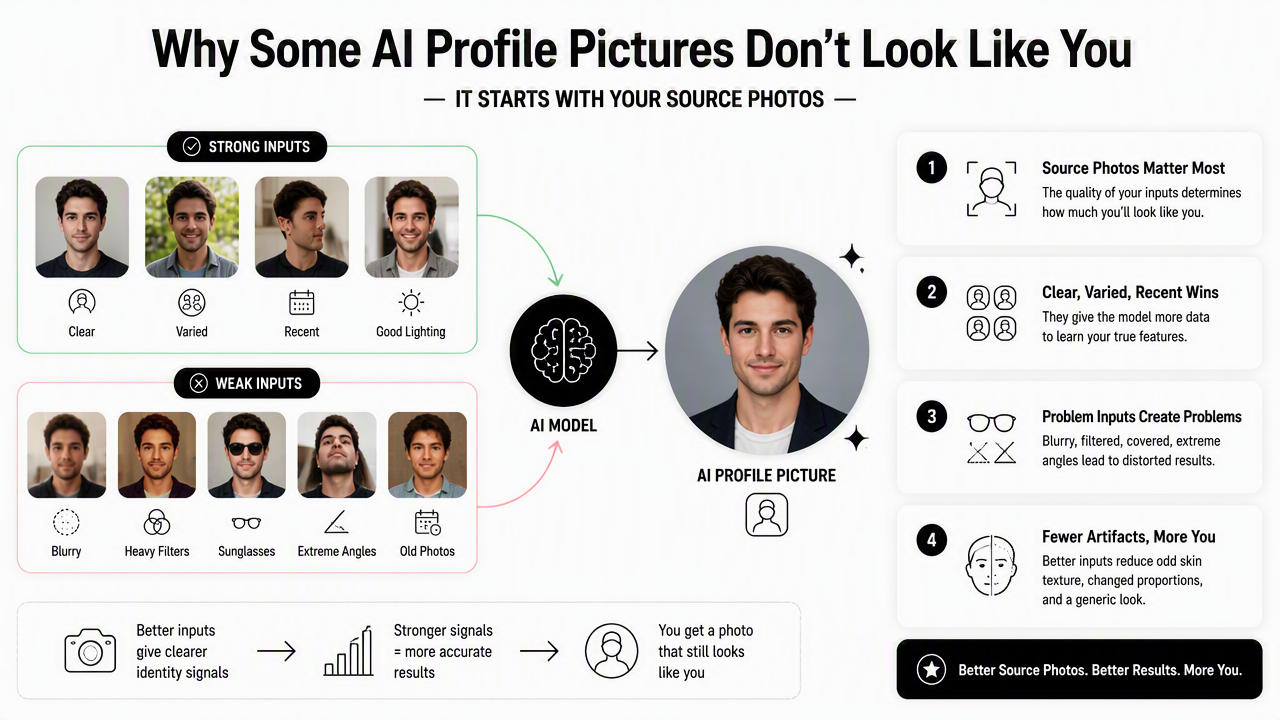
The best input set shows the same face across normal conditions. That means different expressions, indoor and outdoor lighting, and both straight-on and slight-angle portraits. Dating app users may prefer warmer expressions, while job seekers often need calmer, sharper images with neutral clothing.
For creators in fitness, coaching, and personal branding, a profile image must also match the surrounding content style. A fitness creator can keep profile visuals consistent by pairing a headshot workflow with a dedicated fitness Instagram profile picture AI generator.
Best input-photo checklist
- Use recent photos from the past year when possible.
- Include 8 to 15 images if the tool supports training from multiple inputs.
- Choose photos with visible eyes, natural skin texture, and no heavy beauty filters.
- Mix expressions: relaxed smile, neutral face, and candid but clear portraits.
- Avoid group photos, face-obscuring hats, sunglasses, masks, and harsh shadows.
- Include at least one image that already resembles the desired final profile style.
Good inputs reduce overcorrection. A polished output should not erase laugh lines, narrow the nose, widen the eyes, or reshape the jaw unless those edits are explicitly requested for a stylized purpose.
When fewer photos can still work
Some modern tools can generate acceptable profile images from one strong photo, especially when the output is closer to enhancement than full reconstruction. A single-photo workflow works best for simple tasks: cleaner background, better crop, sharper lighting, or a modest wardrobe shift.
Multiple-photo workflows remain safer for people with distinctive features, textured hair, facial hair, glasses, or asymmetry. More variation helps the system separate permanent identity traits from temporary shadows, camera distortion, or a single awkward angle.
Which quality signals make AI profile photos look real?
Authentic AI profile photos look real when facial identity, lighting, clothing, background, and platform crop all agree. Viewers rarely inspect a photo pixel by pixel; instead, they notice when the face is too smooth, teeth look odd, earrings vanish, hands appear distorted, or a studio background feels pasted behind the subject.
Research on AI skills after the pandemic highlights the growing need for digital competence in evaluating AI-assisted work (Ng, Leung, and Su, 2023). Profile photos now require that same judgment: the person choosing an image must know when AI has improved a portrait and when it has pushed the image too far.
Authenticity scorecard for AI portraits
| Quality signal | Looks authentic | Looks too artificial |
|---|---|---|
| Face | Same age range, same eye shape, familiar smile | Younger face, waxy skin, changed jaw or nose |
| Lighting | Light direction matches face and background | Bright face with dark room or impossible shadows |
| Hair | Natural edges and texture | Blended hairline, plastic shine, missing strands |
| Teeth and eyes | Clear but not exaggerated | Perfect teeth, glassy eyes, mismatched pupils |
| Clothing | Fits body and context | Warped collars, fake buttons, odd lapels |
| Background | Believable depth and scale | Blurry fake office, random objects, warped lines |
A reliable profile image passes a quick recognition test. If a friend, colleague, or client would pause and ask whether the photo is real, the edit likely went too far.
Profile context changes the definition of authentic
Authenticity is not one style. LinkedIn usually rewards direct eye contact, simple clothing, and low-distraction backgrounds. Instagram allows more color, stronger personality, and lifestyle cues. A newsletter profile image needs clarity at small sizes, while a dating app image should feel relaxed rather than corporate.
Creators selling products or services need consistency across profile photos and content images. A founder or fitness professional can align portraits with related brand assets through tools such as a fitness Instagram product photo AI generator or a fitness Shopify LinkedIn post AI generator.
How should a profile-photo AI tool be chosen in 2026?
A profile-photo AI tool should be chosen by testing likeness, source-photo requirements, privacy handling, editing control, and export formats before judging style packs. Many generators can make attractive images; fewer can make images that still feel accurate enough for professional and personal identity.
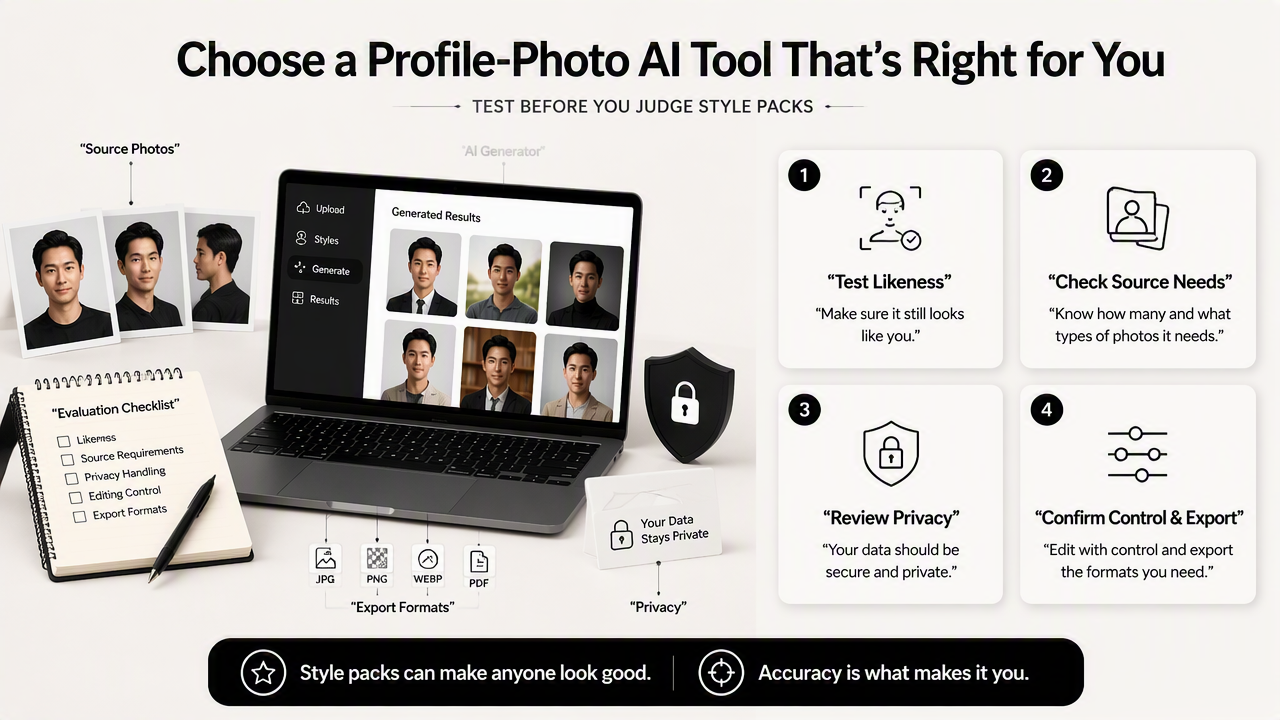
A practical buyer should separate three jobs: identity preservation, image production, and publishing fit. Identity preservation keeps the person recognizable. Image production controls clothing, pose, background, and lighting. Publishing fit prepares the final image for a circular avatar, LinkedIn crop, website bio, or dating profile.
Knowledge organization also matters as AI tools become more complex. A 2023 review in Artificial Intelligence Review examined opportunities and challenges for knowledge graphs, a field tied to structured entity relationships and machine understanding (Peng, Xia, and Naseriparsa, 2023). For profile tools, structured handling of identity, style, platform, and output constraints can make results more predictable.
Decision table for comparing AI profile tools
| Buying factor | Why it matters | Good sign in a tool |
|---|---|---|
| Source-photo guidance | Better inputs create better likeness | Clear instructions before upload |
| Likeness controls | Prevents the face from drifting | Options to regenerate or adjust without changing identity |
| Realistic styles | Keeps the image useful beyond novelty | Professional, casual, creator, and lifestyle options |
| Background control | Matches use case and audience | Office, studio, outdoor, neutral, and brand-color choices |
| Editing limits | Avoids uncanny outputs | Subtle retouching rather than extreme beautification |
| Export formats | Saves time after generation | Square, portrait, and platform-ready crops |
| Privacy language | Helps users judge data risk | Clear handling of uploads, generated images, and deletion policies |
How Looktara handles authentic profile photos
The Looktara platform is best framed as a practical choice for profile images that need to support a real personal brand. It helps users create polished portraits for professional, social, and creator use cases while keeping the focus on usable imagery rather than novelty effects.
Looktara also supports adjacent brand needs. A coach or entrepreneur can use profile images beside newsletter assets through a fitness newsletter profile picture AI generator, then keep social distribution consistent with a fitness Shopify Pinterest pin AI generator. For direct access, visit looktara.com.
Red flags before publishing
- The face looks noticeably younger, thinner, or more symmetrical than real life.
- Skin texture disappears completely, especially around cheeks and forehead.
- Glasses, earrings, hair, or facial hair change between outputs.
- The background has warped lines, fake books, strange plants, or impossible shadows.
- Clothing appears professional at first glance but has melted seams or odd collars.
- The image feels more like a stock model than a real profile owner.
The safest final pick is usually not the most dramatic image. The strongest profile photo is the one that earns trust at small size and still holds up when opened full screen.
FAQ
AI profile photo questions usually center on trust: whether the image looks real, whether it still resembles the subject, and whether it fits the platform. The answers below focus on practical selection and publishing decisions.
Are AI-generated profile photos acceptable on LinkedIn?
AI-generated profile photos are generally acceptable on LinkedIn when the image represents the real person accurately. A professional-looking AI portrait should preserve age range, facial structure, and expression while improving lighting, crop, and background. Overly glamorized images can create a trust gap during interviews, calls, or client meetings.
How many photos are needed for a realistic AI headshot?
Many tools work with one to several photos, but a broader set often improves likeness. A useful input set includes recent, clear images with different expressions and lighting. The goal is not volume alone; the goal is enough variation for the model to understand stable facial features.
Can AI profile photos work for dating apps?
AI profile photos can work for dating apps when they look relaxed, current, and believable. The best dating profile images avoid corporate stiffness and heavy retouching. Natural expressions, realistic clothing, and ordinary settings usually feel more trustworthy than perfect studio portraits or dramatic fashion-style edits.
What makes an AI profile picture look fake?
An AI profile picture looks fake when identity details drift. Common signs include waxy skin, over-bright eyes, unnatural teeth, warped clothing, inconsistent hair, and backgrounds that do not match the lighting on the face. A simple test is whether the image still resembles the person in an unedited video call.
Conclusion
The best artificial intelligence photo generator for authentic profile photos is the one that improves a real image without replacing the person behind it. Strong source photos, restrained editing, realistic backgrounds, and platform-aware crops matter more than flashy style packs. Before publishing, compare several outputs against a recent candid photo and remove any image that changes identity. For profile photos that connect with broader personal-brand assets, head to looktara.com and create a polished set that fits the platform, audience, and real face behind the profile.
Generated by EarlySEO.com