
TL;DR
Strong AI headshot eye contact should look direct, relaxed, and believable, not frozen or overly intense. The best profile images combine camera-facing pupils, soft eyelids, a mild expression, and lighting that keeps the eyes clear without making them look edited.
AI headshot eye contact can change a profile photo from forgettable to trustworthy in less than a second. For job seekers, founders, freelancers, creators, and dating app users, the eyes carry much of the first impression: confidence, warmth, attention, and authenticity. Modern generators can improve a weak selfie, but eye direction still needs human judgment because a technically sharp image can feel odd when the gaze is too rigid, glassy, or misaligned. Looktara supports professional image creation for people who need polished profile photos without a traditional studio session, including a dedicated fitness, LinkedIn, and resume headshot AI generator for career-facing use cases.
Table of Contents
What is AI headshot eye contact?
AI headshot eye contact is the apparent direction, clarity, and emotional quality of the eyes in an AI-generated or AI-edited professional portrait. It matters because viewers read the gaze as a social signal before they study clothing, background, or image resolution.
AI headshot eye contact: the combination of pupil direction, eyelid tension, catchlights, face angle, and expression that makes a generated headshot appear to look naturally toward the camera.
A good headshot does not need a stare. It needs the impression of attention. The face can be turned slightly, the shoulders can angle away, and the smile can stay subtle, as long as the eyes feel connected to the viewer.
Key insight: natural eye contact in a professional photo is not just "eyes at camera." It is gaze direction plus believable facial muscle behavior.
Research on artificial intelligence and human judgment is relevant here because people respond socially to machine-made images. The 2023 Annual Review of Psychology article The Moral Psychology of Artificial Intelligence examined how humans evaluate AI systems, including trust and moral perception. In headshots, that same trust filter appears in a simpler form: does the person look credible, attentive, and real?
Core parts of believable gaze
| Element | What it affects | What looks natural |
|---|---|---|
| Pupil direction | Attention | Pupils aimed near the lens, not drifting sideways |
| Eyelids | Relaxation | Slightly open, not startled or sleepy |
| Catchlights | Liveliness | Small highlights in both eyes |
| Face angle | Professional polish | Chin and head turned only slightly |
| Expression | Warmth | Mild smile or calm neutral face |
The strongest images usually keep the eyes sharp while allowing the rest of the face to stay human. Tiny asymmetry is normal. Perfect symmetry often makes an AI portrait feel less believable.
How does eye direction change trust and confidence?
Eye direction changes trust and confidence by signaling attention, intent, and comfort. Direct but relaxed gaze tends to feel more confident, while a hard stare can feel aggressive and an off-camera gaze can seem distracted unless the image is styled as editorial.
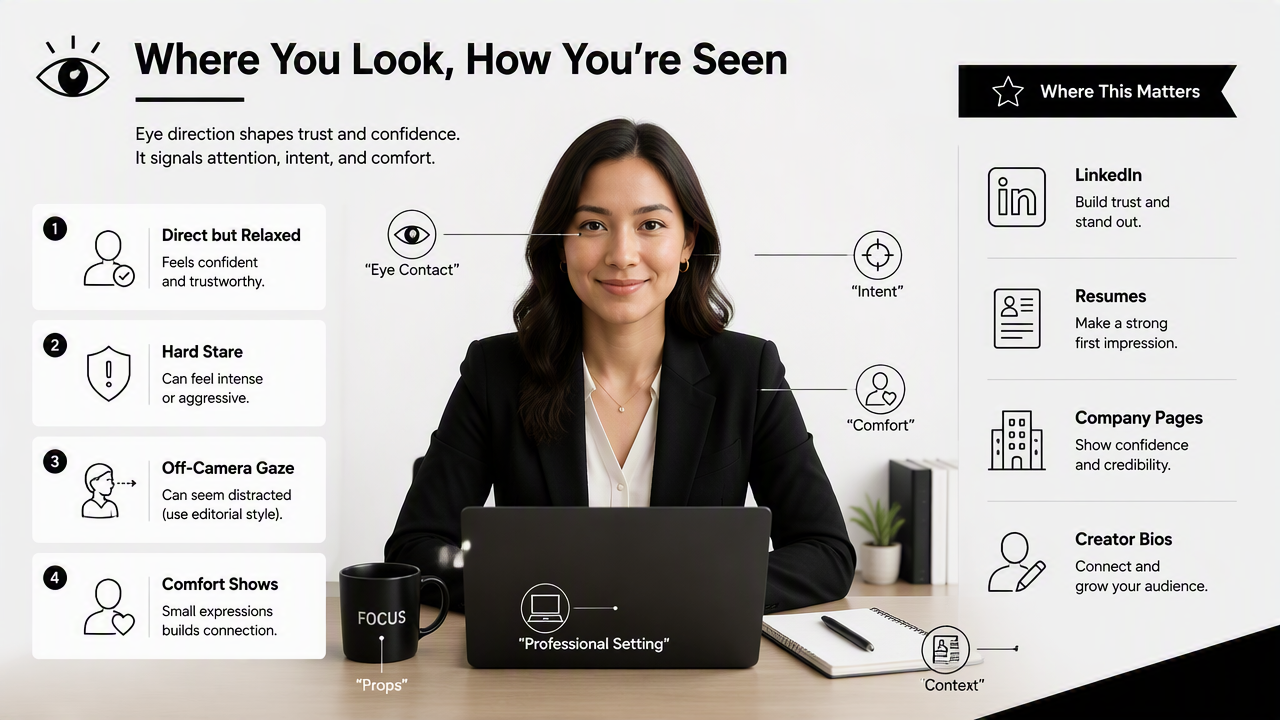
For LinkedIn, resumes, company pages, and creator bios, the safest visual message is calm presence. The person appears engaged but not theatrical. That balance becomes especially important when a headshot is generated from casual selfies, because the AI may sharpen the face while preserving awkward gaze habits from the source image.
Gaze effects by profile goal
| Goal | Best eye direction | Risk to avoid |
|---|---|---|
| LinkedIn job search | Direct gaze with relaxed eyelids | Over-wide eyes that look anxious |
| Founder profile | Direct gaze with slight head angle | Too much intensity or a forced smile |
| Freelancer portfolio | Camera-facing gaze, natural expression | Side glance that feels unavailable |
| Creator profile | Direct or near-direct gaze | Over-retouched eyes with no texture |
| Dating profile | Soft direct gaze | Corporate stiffness or blank expression |
A dating app photo and a board biography should not look identical. Still, both benefit from eyes that seem awake, warm, and present. The styling around the gaze changes, while the basic trust signal stays similar.
Human detection of synthetic faces also matters. A 2023 Journal of Cybersecurity study, Testing human ability to detect 'deepfake' images of human faces, examined how people identify deepfake face images. The study topic is a reminder that viewers inspect faces for authenticity cues, and the eye area is one of the first places that can raise doubt.
A professional AI headshot should pass two tests: it should look flattering at first glance and still look believable after a closer look.
Strong gaze supports authority, but warmth comes from the surrounding expression. The best result usually combines direct pupils, soft lower eyelids, relaxed brows, and a mouth shape that matches the eyes.
How can AI headshots make eye contact look natural?
AI headshots can make eye contact look natural by starting with clear source photos, using prompts that specify relaxed gaze, and rejecting outputs with mismatched pupils, frozen eyelids, or unnatural shine. The goal is not maximum intensity; the goal is believable attention.
Good inputs still matter in 2026. A blurry selfie, dark sunglasses, heavy side lighting, or a strong off-camera glance gives the model less reliable eye information. AI can correct many problems, but it often guesses when the eyes are hidden or inconsistent across uploads.
Practical checklist for better gaze
- Choose source photos where both eyes are visible and open.
- Prefer soft front lighting or window light that shows the iris clearly.
- Keep the camera near eye level rather than far above or below.
- Select images with a relaxed mouth, since the eyes and smile need to match.
- Avoid heavy filters that erase eyelid folds and skin texture.
- Review the final image at both thumbnail size and full size.
The Looktara platform is most useful when the source photos already show a natural expression. AI generation can improve wardrobe, background, lighting, and polish, but the best final portraits come from inputs where the person already looks comfortable.
Prompt language that helps the eyes
- Use: "natural direct eye contact, relaxed eyelids, soft confident expression."
- Use: "professional headshot, eyes looking toward camera, subtle smile."
- Avoid: "piercing stare," "perfect eyes," or "ultra intense gaze."
- Avoid: "flawless face," if the result starts to remove normal eye texture.
AI eye contact correction tools can be helpful for video calls and portraits, but heavy correction may create a mismatch between the pupils and head angle. A face turned far away from the camera with eyes snapped forward often feels unnatural.
The most believable generated headshots keep the correction small. Subtle gaze alignment usually beats a dramatic eye-direction fix.
Hannah Zeavin's 2021 MIT Press book The Distance Cure focuses on mediated interaction and remote care, not headshots specifically. Still, its subject points to a broader reality of modern communication: faces on screens carry emotional weight when people meet, hire, follow, or date from a distance.
What eye contact mistakes make AI portraits look fake?
AI portraits look fake when the eyes are too symmetrical, too glossy, misaligned, or emotionally disconnected from the rest of the face. The most common problem is not bad image quality; it is a gaze that looks technically correct but socially wrong.
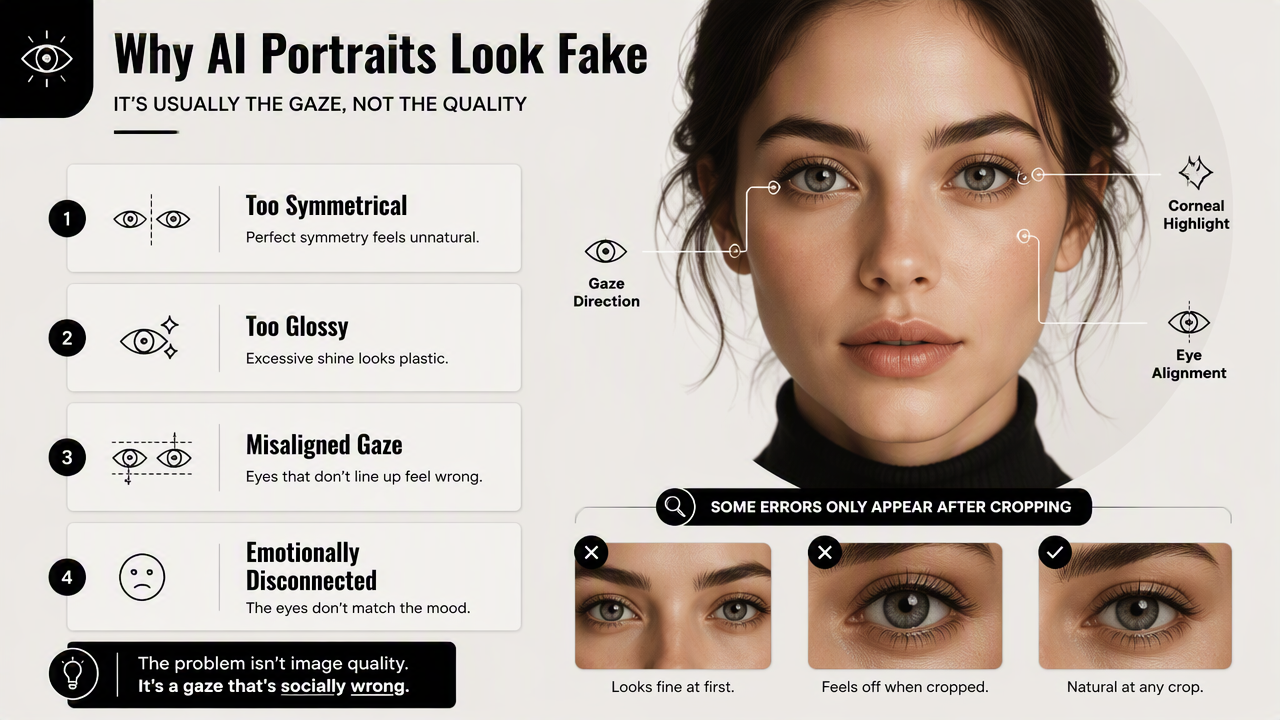
Some errors are obvious. Others only appear after the image is cropped into a LinkedIn circle, resume header, website bio, or dating app grid. That is why final review should happen in the same format where the headshot will appear.
Red flags in generated eyes
- Pupils point in slightly different directions.
- One catchlight is missing or placed oddly.
- Eyelids look stretched, startled, or overly smooth.
- The gaze is direct, but the head angle suggests a side glance.
- The smile is warm, but the eyes look blank.
- The whites of the eyes look too bright compared with the skin.
- Both eyes appear identical in shape and shine.
A false "perfect" look can be less persuasive than a real, slightly imperfect one. Real faces have small differences between the left and right eye. When an AI tool removes every crease and shadow, the person may look less experienced, less approachable, or simply less real.
Quick review test before posting
| Test | How to judge it | Pass signal |
|---|---|---|
| Thumbnail test | View the image very small | Eyes still feel clear and engaged |
| Zoom test | Inspect pupils and eyelids | No mismatch or painted texture |
| Expression test | Cover the mouth, then the eyes | Both areas suggest the same mood |
| Context test | Place it near a bio or resume | Gaze fits the professional setting |
Eye contact can also be too strong. A headshot for a finance executive may benefit from a steady look, while a wellness coach or dating profile may need a softer expression. Context decides the right intensity.
People should also avoid using a headshot that no longer resembles their real appearance. Trust starts before the meeting, but it can disappear quickly when the profile image and real face feel disconnected.
What should professional photos prioritize in 2026?
Professional photos in 2026 should prioritize believable identity, clear eyes, natural expression, and platform-specific fit. AI polish is now common, so the stronger advantage is authenticity: an image that looks current, flattering, and credible without looking overproduced.
Recruiters, clients, followers, and potential dates see profile images in fast, small formats. A headshot must work as a thumbnail first, then hold up under closer review. The eye area should remain crisp, but not sharpened so much that it separates from the rest of the face.
Decision guide by use case
| Use case | Best expression | Eye contact style | Recommended crop |
|---|---|---|---|
| Calm, confident | Direct and relaxed | Head and shoulders | |
| Resume | Neutral to slight smile | Direct | Clean, formal crop |
| Founder page | Warm authority | Direct with slight head angle | Chest-up portrait |
| Creator bio | Approachable | Direct or near-direct | Flexible crop |
| Dating app | Friendly, real | Soft direct gaze | Less corporate crop |
Looktara can help professionals create headshots that fit different contexts without booking separate studio sessions. For people comparing styles, looktara.com is a practical starting point because the final image can be judged against the exact platform where it will appear.
The next step for AI headshots is likely more identity consistency and better micro-expression control. Instead of simply generating a polished face, stronger systems will need to preserve the person's real eye shape, natural eyelid behavior, and familiar expression across multiple outfits and backgrounds.
Selection rules for a final image
- Pick the photo that still looks like the real person.
- Favor relaxed confidence over dramatic intensity.
- Match the expression to the platform and audience.
- Reject any image where the eyes feel disconnected from the smile.
- Test the crop before uploading.
In 2026, the best AI headshot is not the most edited image. It is the image that looks professional, current, and easy to trust.
FAQ about AI headshot eye contact
Should an AI headshot always look directly at the camera?
An AI headshot should usually appear to look toward the camera for LinkedIn, resumes, company bios, and service pages. A slight head angle is fine when the pupils still feel connected. Strong side glances work better for editorial or creative portraits, not for most trust-based professional profiles.
Can AI fix eyes that are not looking at the camera?
AI can often adjust off-camera eyes, but the best results come from small corrections. Large gaze changes can create mismatched pupils, odd eyelids, or a face angle that no longer fits the eyes. Source photos with near-camera gaze usually produce more believable final headshots.
What makes AI-generated eyes look fake?
Generated eyes look fake when they are too glossy, too symmetrical, over-brightened, or emotionally mismatched with the mouth. Viewers may not identify the exact flaw, but they often sense that something feels off. Natural eyelid folds, realistic catchlights, and mild asymmetry help preserve credibility.
How many AI headshot options should be reviewed?
Several options should be reviewed because small gaze differences change the impression of the same face. The best choice is usually not the sharpest or most polished image. It is the one where the eyes, mouth, posture, clothing, and intended platform all send the same message.
Conclusion
AI headshot eye contact works best when the gaze feels attentive, relaxed, and human. Direct pupils, soft eyelids, realistic catchlights, and a matching expression create more trust than extreme sharpness or heavy correction.
A practical next step is to gather clear source photos, generate several polished options with Looktara, then compare the finalists at thumbnail size and full size. For career profiles, founder pages, creator bios, or dating apps, head to looktara.com and choose the image where the eyes feel natural before anything else.
Generated by EarlySEO.com